Cramps, Claims and the Counter: CBD's Quiet Push Into Period Pain
Photo: elsaolofsson, CC BY 2.0, via Wikimedia Commons
Ask anyone who menstruates what they have tried for cramps and you get a list that reads like a minor history of folk medicine: hot water bottles, ibuprofen on a strict timer, raspberry leaf tea, a tens machine, gin. Lately, another item has joined the list. CBD.
It is not hard to see why. The products are everywhere, the packaging is soft and pink and unthreatening, and the language — 'calm', 'balance', 'comfort' — lands neatly on a symptom that has been dismissed by doctors, colleagues and occasionally one's own family for a very long time.
What is harder to find is a straight answer about whether any of it works.
A symptom we are weirdly relaxed about
Dysmenorrhoea, to use the clinical term, affects the majority of menstruating people at some point, and a substantial minority severely enough to miss work or school. First-line treatment is unglamorous and effective: NSAIDs like ibuprofen, started early, plus hormonal contraception for some people. NICE guidance has said so for years.
And yet the lived experience is often one of delay. People are told to wait, to go on the pill, to see how it settles. Endometriosis takes an average of years to diagnose. Against that backdrop, a £22 bottle of drops that promises to take the edge off is not an irrational purchase. It is a rational response to a service that has not taken the problem seriously.
That is the gap the CBD market has walked into, and it has walked in wearing a very nice pair of pastel joggers.
What the evidence can and cannot say
Here is the honest position in 2026: there is promising laboratory work, a handful of small human studies and a lot of anecdotal reporting. There is not the kind of large, well-controlled trial that would let a pharmacist recommend a specific product at a specific dose for period pain.
Some of the most-cited research has looked at CBD in endometriosis-related pain, and the results are interesting rather than conclusive. Sample sizes are small, follow-up is short, and formulations vary wildly — which is a problem when one bottle is full-spectrum with a bit of THC and the next is an isolate in sunflower oil.
Add to that the absorption issue. Oral CBD has poor and unpredictable bioavailability, which is a technical way of saying that the number on the label and the amount that reaches your bloodstream are not close friends.
The advertising grey zone
CBD sold as a food supplement cannot make medicinal claims. It cannot say it treats period pain, and it cannot say it treats PMDD, premenstrual anxiety or anything else that has a clinical name. In practice, brands get around this with a particular kind of linguistic gymnastics: 'for that time of the month', 'your cycle, supported', a testimonial from a customer who says it 'changed everything'.
The Advertising Standards Authority has been fairly consistent on this, and the rules have not loosened. If a product's marketing implies it treats a condition, the claim is in trouble whether or not the word 'treat' appears anywhere on the bottle.
None of which means the products are dangerous. It means the marketing is doing work the evidence cannot do.
What people are actually doing
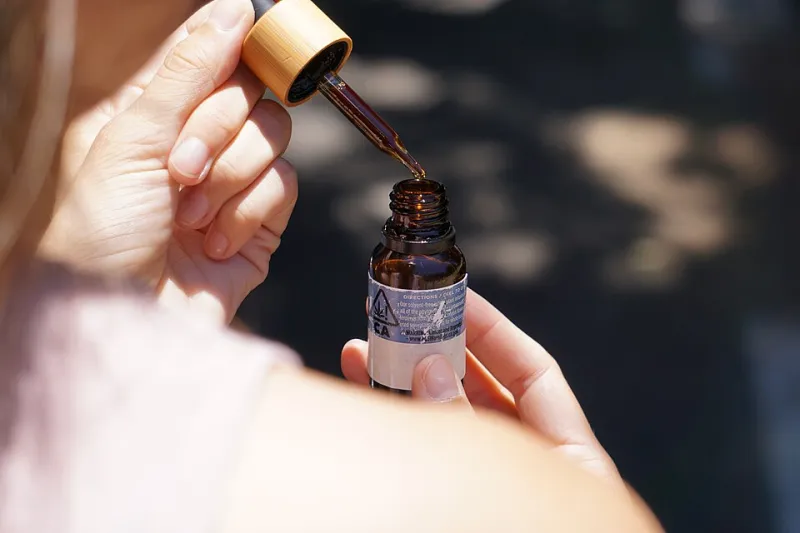
Talk to women who use it and a pattern emerges: most are not replacing ibuprofen. They are layering. A CBD oil in the evening when the cramping is at its worst and sleep is impossible. A balm rubbed into the lower back. A drink on day one because it feels like a ritual of care as much as a pharmacological intervention.
There is something quietly sensible in that. The ritual matters. Being listened to matters. But there are practical considerations that rarely make it onto the label.
Four things worth knowing before you buy
- Interactions are real. CBD inhibits certain liver enzymes, which can affect how other medicines are metabolised. If you are on warfarin, epilepsy medication or anything with a narrow therapeutic window, speak to a pharmacist first.
- Pregnancy and trying to conceive. The official advice is to avoid CBD. The evidence on fertility and fetal development is not reassuring enough to gamble on.
- Start low and patch test. Especially with balms and anything going near sensitive skin.
- Price per milligram, not price per bottle. Menstrual-focused products frequently cost more per milligram than identical formulations in different packaging. Compare, and be annoyed.
The blind spot, not the breakthrough
The most interesting thing about CBD and period pain is not that it might work. It is what the market's existence tells us about the treatment of menstrual health in Britain: that the gap between what people need and what they are offered has become wide enough for a whole product category to fit inside it.
CBD may eventually earn a place in that conversation, backed by proper trials and honest labels. For now, treat it as what it is — an unproven option with a low risk profile, being sold with a lot of confidence it has not earned.
And if the cramps are bad enough that you are buying supplements at midnight, that is worth a conversation with a GP too. Not because the oil is dangerous, but because you deserve more than a workaround.