The Gate Is Not a Courtroom: A Legal Cannabis Script at a UK Festival in 2026
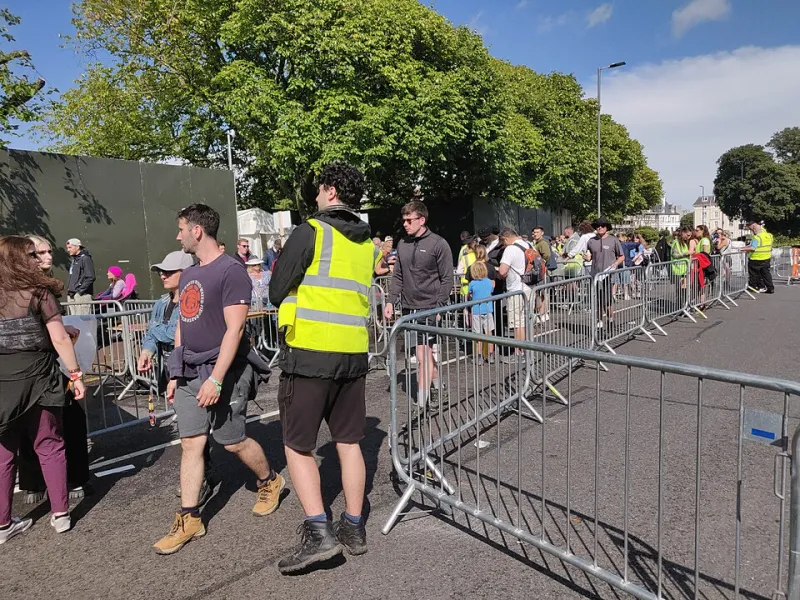
Photo: Tim Sheerman-Chase, CC BY 2.0, via Wikimedia Commons
Festival gates are strange thresholds. On one side: a car park, a queue, a stranger in a hi-vis asking you to open your bag. On the other: a weekend of overpriced noodles and a portable toilet you’ll remember for the rest of your life. In between sits a question that has become oddly central to the British summer for a small but growing group of people: what happens when the tub in your rucksack is legally prescribed cannabis?
As the 2026 season approaches, the answer remains less a rulebook than a ritual. Festivals are private events on private land, and they can set their own entry conditions. The police still police. Security still searches. And prescribed patients still walk up to the gate with a legally dispensed product in their bag and a knot in their stomach. This isn’t legal advice. It’s a field guide to a conversation that thousands of people will have this summer, usually in a matter of seconds, often with someone who has never heard of a medical cannabis clinic.
The two-tub problem
If you are prescribed cannabis in the UK, you will probably know the drill: original packaging, dispensing label with your name, clinic letter or prescription copy, and a vaporiser rather than a spliff. At a festival gate, that paperwork becomes a small piece of theatre. The tub is not the issue. The issue is whether the person looking at it recognises what it is.
Patients report wildly different experiences. Some sail through after a thirty-second chat. Others are pulled aside, made to wait, and eventually allowed in with an apology. A few have had tubs confiscated by stewards who simply didn’t know that prescribed cannabis is a lawful medicine. The inconsistency is the point. There is no single festival policy. Some events publish a medical exemption process and ask you to register in advance. Others say nothing at all and leave it to the gate team.
The practical advice from patients who have done this before is boringly sensible: bring more proof than you think you need, keep everything in its original container, and don’t bury it at the bottom of a bag like contraband. If you are open about it, the conversation tends to be shorter. If you are furtive, the dog has already told them you’re nervous.
Dogs, bins and the theatre of the search
The sniffer dog is the great misunderstood character of the festival gate. Most dogs you see at UK festivals are passive alert dogs working car parks, queues and entrance lanes. They are trained to sit when they smell a target odour. Cannabis is one of those target odours. A dog cannot tell the difference between a legally prescribed tub and a bag of something bought in a park. It just smells cannabis.
This is where the amnesty bin enters the story. Amnesty bins are usually placed before the search lane. They exist so that people can dispose of illegal substances without being searched with them. They are not for your prescription. Putting a legally dispensed medicine in an amnesty bin is not a clever loophole; it is just throwing away your medicine. And it won’t help you if the dog has already sat next to you.
The search itself is usually a bag check, a pat-down, and a question. Some festivals use more thorough searches; some use none at all. The variation is enormous. What matters is that security staff are not judges. They are applying a licence condition and a house policy. They can refuse entry. They can call a supervisor. They can call the police. They cannot give you a definitive legal ruling, and they are not trained to.
What organisers actually train for
Festival organisers will tell you that medical cannabis is on their radar, but it is often on the radar in the same way that a hundred other edge cases are: as a line in a briefing document. Accessibility teams and medical teams tend to be better informed than the front gate. If a festival offers a medical exemption process, use it. If it offers an accessibility or welfare contact, ask them in advance what the gate team has been told.
The honest truth is that training varies. Some stewards have been briefed on prescribed cannabis. Many have not. Some events brief their security contractor; others rely on the contractor’s own training. The result is a postcode lottery that mirrors the wider UK cannabis wellness divide. A patient in one field gets a shrug and a wave-through; a patient in the next gets a half-hour delay and a confiscated tub.
Organisers are also managing a licensing environment that is risk-averse. They do not want to be seen to be allowing drugs. They do not want to be the festival that made the news. That tension is what produces the quiet, discreet, don’t-ask-don’t-tell culture that surrounds medical cannabis at events. It is not a policy. It is a vibe.
The patter: how the conversation usually goes
The most useful thing you can bring to the gate is not a legal argument. It is a short, calm sentence. Something like: ‘I have a legal prescription for this, it’s in my name, here’s the label and my clinic letter.’ Then stop. Don’t lecture. Don’t quote the Misuse of Drugs Regulations. Don’t tell the steward they’re breaking the law. The steward is a person in a hi-vis who has been on their feet for six hours.
If the steward doesn’t know what to do, ask for a supervisor or the medical team. If they want to confiscate, ask for the reason and for a name. You are not obliged to be a test case. You are also not obliged to be a pushover. The middle path — polite, prepared, persistent — is the one most patients report working.
What you can reasonably expect
You can reasonably expect to be searched. You can reasonably expect the dog to smell your medicine. You can reasonably expect that some gate staff will not know the law. You can reasonably expect that the festival’s policy, if it has one, is not the same as the next festival’s policy. You can reasonably expect that the police, if called, will have a better grasp of the legal position than the steward — but you cannot expect them to be called at all.
What you cannot expect is consistency. That is the frustrating, human, very British truth of the festival gate in 2026. The law is clearer than the culture. The medicine is legal; the conversation is not. And until festivals publish proper medical cannabis guidance and train their gate teams to follow it, patients will keep doing what they have always done: packing the tub, bringing the letter, and hoping the person in the hi-vis has had a better briefing than the last one.